Insights

Reflections on strategy, governance, and institutional change in higher education.

How not to do university strategic planning

Strategic planning is a significant undertaking for any research university or academic medical center. Yet across higher education, a striking number of institutions end up with remarkably similar outcomes: glossy PDFs posted on institutional websites, filled with broad aspirations, familiar language, and lowest common denominator priorities. These plans often articulate values everyone agrees with, but few decisions anyone can act on. The question is not why universities plan, but why so many plans look alike and fail to shape real choices.

The answer usually lies in how the process is designed. When strategic planning is under-resourced or poorly sequenced, it tends to generate large volumes of unstructured input, restate existing commitments, and avoid the hard tradeoffs that strategy requires. The result is clarity in tone, but ambiguity in direction.

Misstep #1: Crowd-Sourcing Fundamental Ideas

One of the most common missteps is launching broad stakeholder engagement before leadership clarity exists. Universities often begin by soliciting ideas from faculty, staff, students, and external partners without first articulating a small set of high-level priorities. This approach virtually guarantees diffuse input. Participants understandably contribute everything they care about, producing long lists of aspirations that are difficult to synthesize into strategy. The planning team is then forced to smooth differences rather than sharpen choices, leading to language that offends no one but commits to very little. Many of the generic plans that sit quietly on university websites are the predictable outcome of this sequence.

A more effective approach begins with early leadership alignment. A concise set of priorities articulated at the outset provides a clear frame for engagement. It ensures that stakeholder input is focused on advancing the institution's direction rather than expanding the universe of possibilities. This sequencing respects the time and insight of the campus community and produces input that is far more actionable.

Misstep #2: Failure to Consider Practical Constraints at the Start

A second common failure is treating financial analysis as something to address after priorities are defined. Strategic choices are only credible if they align with realistic assessments of cost, revenue potential, and institutional capacity. Too many planning efforts land on priorities first and ask what it will take to deliver them later. When financial realities eventually surface, plans must be revised, timelines slip, and confidence erodes.

Integrating financial analysis early changes the nature of the conversation. It forces tradeoffs into the open, grounds ambition in capacity, and results in priorities that institutions can actually execute. Without this discipline, even well-crafted strategies struggle to move from paper to practice.

---

Universities often underestimate what a high-quality planning process requires. Early leadership alignment, analytical rigor, and financially grounded decision-making are not optional elements. When scope, sequencing, and resources do not match ambition, the outcome is rarely strategy. It is documentation.

Strategic planning can create real value, but only when institutions design the process to produce decisions rather than consensus language.
Implications of a 15% indirect cost cap

Don't think of the NIH indirect rate cap as primarily an attack on research. It's actually:

(a) an attack on everything else these institutions do, and
(b) targeted at a small group of elite institutions.

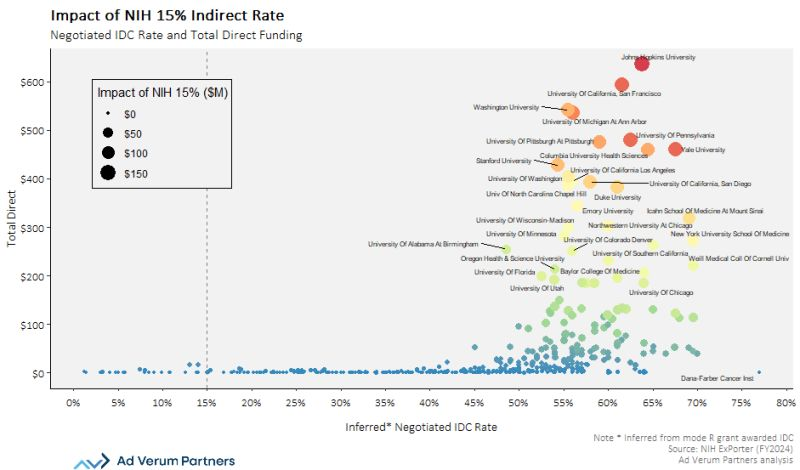
Ad Verum Partners' evaluation of the impact reflects a grant-by-grant analysis of every NIH award from 2024. The horizontal axis represents the inferred negotiated rate, and the vertical axis represents current direct NIH funding.

Figure 1: Impact of NIH 15% Indirect Rate - Negotiated IDC Rate and Total Direct Funding

Re: (a) how do you respond to this cap? Cut "indirect" expenditures? Nope, those are mostly fixed costs of facilities. Cut direct research? Nope, those salaries are mostly funded on grants and would result in a corresponding revenue decline. The answer: cut something else. Indirect revenue shows up as unrestricted funds for universities, so they will have to cut something else outside research—financial aid, non-grant-funded academic programs, etc.

Re: (b) observe how concentrated the impact is, and ponder the names—large, "elite" institutions.

In other words, this cap triggers a fundamental reassessment of strategy, particularly for the largest, most research-intensive institutions. I don't know what the new equilibrium is, but whether this gets reversed tomorrow or never, it's clearly time to think through the new environment, and crucially not to view this as "a research problem" only.

This issue represents a seismic shift for large research universities. My focus is on the small share of institutions for which indirect cost recovery is a large part of the economic model. The rug being pulled out from under indirect reimbursement will have profound ramifications for them, in both research and far beyond.

My day job is helping university leaders to set and execute strategy, so my focus is how universities can navigate this change. To begin, you must understand your economic model and external environment. In other words, understand the facts.

The Post-War Partnership Model

Since at least WWII, universities and the Federal government have worked in partnership to advance research. Universities took on real costs in the expectation that the government would defray them over time, so long as their faculty continued producing research ideas worthy of government funding. The Federal share of higher education research peaked at 74% in 1966, and since declined to 55% (source: NSF HERD Survey). Institutions have largely made up the difference—increasing from 8% in the 1960s to 25% today—investing in research from myriad sources such as endowment, clinical activities, and surplus from degree programs.

One could debate to what extent that model is still fit for purpose. That's a public policy question. The returns to society and the US economy from university research massively outweigh the costs, but the fundamental partnership model is clearly under stress.

Key Fact #1: Concentration of Research

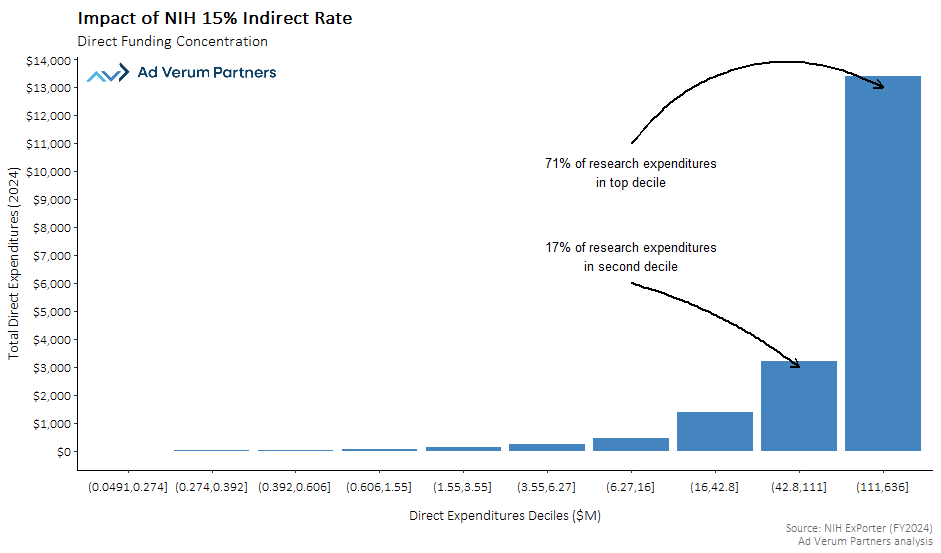
Direct research activity is highly concentrated. The top 2 deciles of institutions by NIH funding accounted for 87% of total NIH direct funding of higher education in 2024. Surely there are many reasons for this. One must be the benefit to researchers of sharing space with both a critical mass of colleagues in their discipline as well as similar groups in other fields. Another must be the scale benefit of university infrastructure.

Figure 2: Impact of NIH 15% Indirect Rate - Direct Funding Concentration

Larger research volumes associated with higher indirect rates. Indirect rates rise with research scale, meaning indirect cost recovery is even more concentrated. In those top two deciles the lowest negotiated rate is 45% and the median is 58%.

Figure 3: Impact of NIH 15% Indirect Rate - Direct Funding and Negotiated IDC Rate

Indirects are best conceived of as "infrastructure," not "overhead." Research infrastructure—whether lab buildings, instrumentation, utilities, shared facilities, oversight of animal and human subjects protocols, etc.—exist to enable research. The Admin portion of F&A has been capped at 26% since 1994. So the 45–69.5% range in the top two deciles largely comes down to approximately 20–40% for Facilities.

The challenge splits into two dimensions:

Long-term: Doing that in a way that minimizes the upset to the power of and natural scale advantages of top-flight research facilities.

Short-term: Facilities costs are essentially fixed, so universities can't cut the underlying expenses in response to the NIH revenue cut. Universities need to find something else to cut in response to the indirect shortfall. Those cuts will likely come from all over, even in areas that have nothing to do with research—PhD student funding in the arts and humanities, undergraduate financial aid, and more.

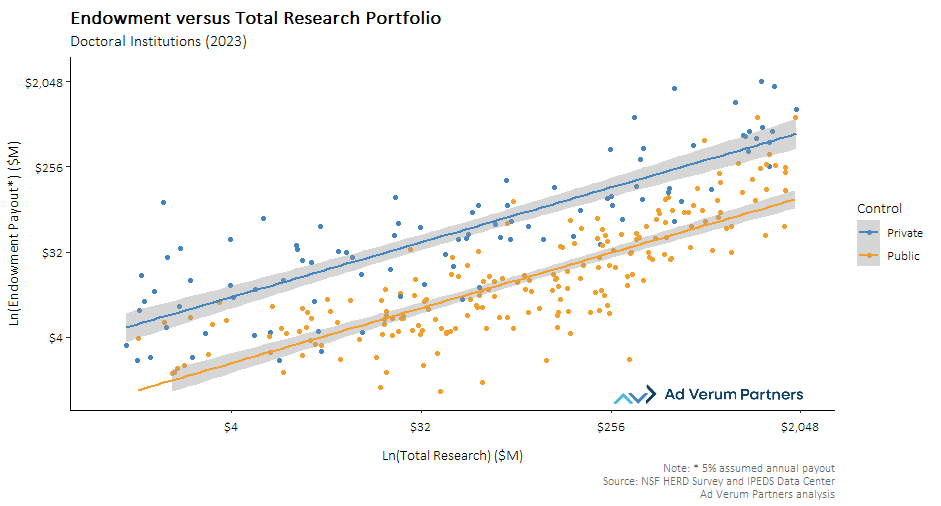
Larger research volumes associated with larger endowments. No surprise, universities with larger research portfolios tend to have larger endowments. There's a clear relationship between research portfolio and endowment size, for both private and public institutions.

Figure 4: Endowment versus Total Research Portfolio

It's not easy to redirect endowment spending to cover this indirect shortfall. It will be even harder if the tax on university endowments is increased. That's another shoe to drop, and a topic for a subsequent discussion.